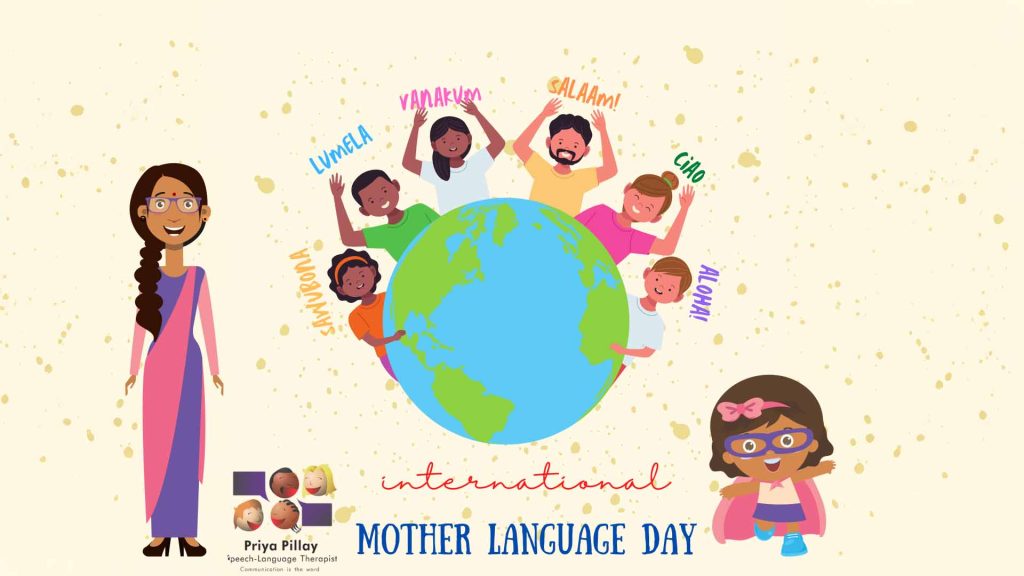
Hi Everyone It has been a long time since I’ve posted on my Blog. We shall blame it on life with is very many challenges Let’s get into shall we? February 21st, is International Mother Language Day; the language of the heart and mind.
Our mother language is the language that a child grows up with, a language we have been speaking from childhood. It’s also known as our first language or native language. Being fluent in his mother tongue benefits an individual in so many ways. A lot of research has suggested that mother tongue education is an important step in language learning for children. In fact, there are studies which show that learners with a strong first language foundation seem to have a better ability to learn other languages, generally develop good language skills later in life and have better academic success. Learning does not start in school. It starts in the home and in the child’s mother tongue.
Parents need to communicate with their children in their mother tongue to not just facilitate better learning but to also connect them to their culture and history. As a South African with South Indian heritage, my parents ensured that my brother and I learnt to speak Tamizh; I am unable to read or write in this beautiful language but I am always grateful that I can understand and appreciate the deep significance and history that comes with my mother language.
A few tips to stimulate your child’s speech and language skills, because I can never emphasize this enough. Also, this stimulation advise can be applied to any Mother language

Imitation is one of the earliest language stimulation techniques that you can start using with your infant. Your baby will develop simple actions before he develops sounds, so make sure you copy these actions at every opportunity. As soon as your baby starts making noises (gurgling, squealing, cooing) you can start imitating them. By simply copying your baby’s sounds, you are teaching the basics of conversation skills- turn-taking. Your baby is learning that when he says something, then you say something too. Soon your child will be imitating you, which is how he will begin to learn words.
Running commentary; children learn language (words and sentences) through listening to others. The more language they are hearing, the more readily they are able to pick up new words and phrases. Often children have to hear a word many times before they will attempt to say it, which suggests that Mums and Dads need to do a lot of talking to encourage their children to learn new words. A simple way to do this is by providing a ‘running commentary’ throughout the day. “Pick up the cup, oops! Dropped it! Pick it up again. Yum, yum, yum! Yummy drink! Hmm, where’s the spoon? Here’s the spoon. Stir the drink. Stir, stir, stir. More please.”
By commenting on your child’s immediate interests and actions, you are providing them with words and sounds that are motivating in that moment, and it is these words and sounds that they will be more likely to say.
When your child begins to use single words you will most likely hear a lot of labels (nouns) such as kitty, puppy, milk, ball. Right now these are the most useful words for your child as these are the things that he can see and touch. Your child does not know all of the words yet, and may be simply pointing to different things and looking at you questioningly. When this happens, give your child the word. Note: if your child pronounces words incorrectly, it is important for you to repeat the word correctly. For example, if your child says ‘kikky’ instead of ‘kitty’, it is important that you show him the correct way to say that word e.g. “Yes, it’s a kitty’.
Children learn language from their parents, and if you repeat his error (‘kikky’) you are teaching him that this is the right way to say that word.
Above all else, it is so important that you simply spend time with your child. This may sound like a super obvious thing, however it is a point that needs to be emphasized. You don’t need to spend hours and hours doing structured play with your child; in fact it is just as important for you to involve your child in regular everyday activities such as cleaning up, washing the clothes, gardening, and preparing food. If you can start to incorporate some of the above techniques into these daily activities, the task will not seem so daunting, and it won’t take up extra time in your hectic lives
What is your mother language? And have you been able to teach your little one this language?
Let me know
Your Super Speechie
Priya